Category: Travel reflections

  • Are you capable of truly doing nothing?

    Are you capable of truly doing nothing?

    Most of the time, I travel to explore. But summer holidays are just different. It is the only time of the year where the sole purpose of going somewhere is to do nothing. Nothing being defined as sleeping in, proceeding to the beach right after breakfast, staying at the beach until about 6 p.m., showering, getting ready for dinner and going to bed after chilling on the balcony for a few hours after dinner. It is perfect, but not easy.

    In my daily year-round routine, I get up at 5:24 a.m. (because the alarm goes off at 5:15 and I allow myself one snooze), I work out before a full day in the office followed by cooking and other household chores. I go to bed early and fill my weekends with more chores, longer gym sessions and sometimes travel. I am generally unable to sit still. I would always find something that needs to be done, and leisurely activities, such as reading a book happen very rarely when I am in my working mode.

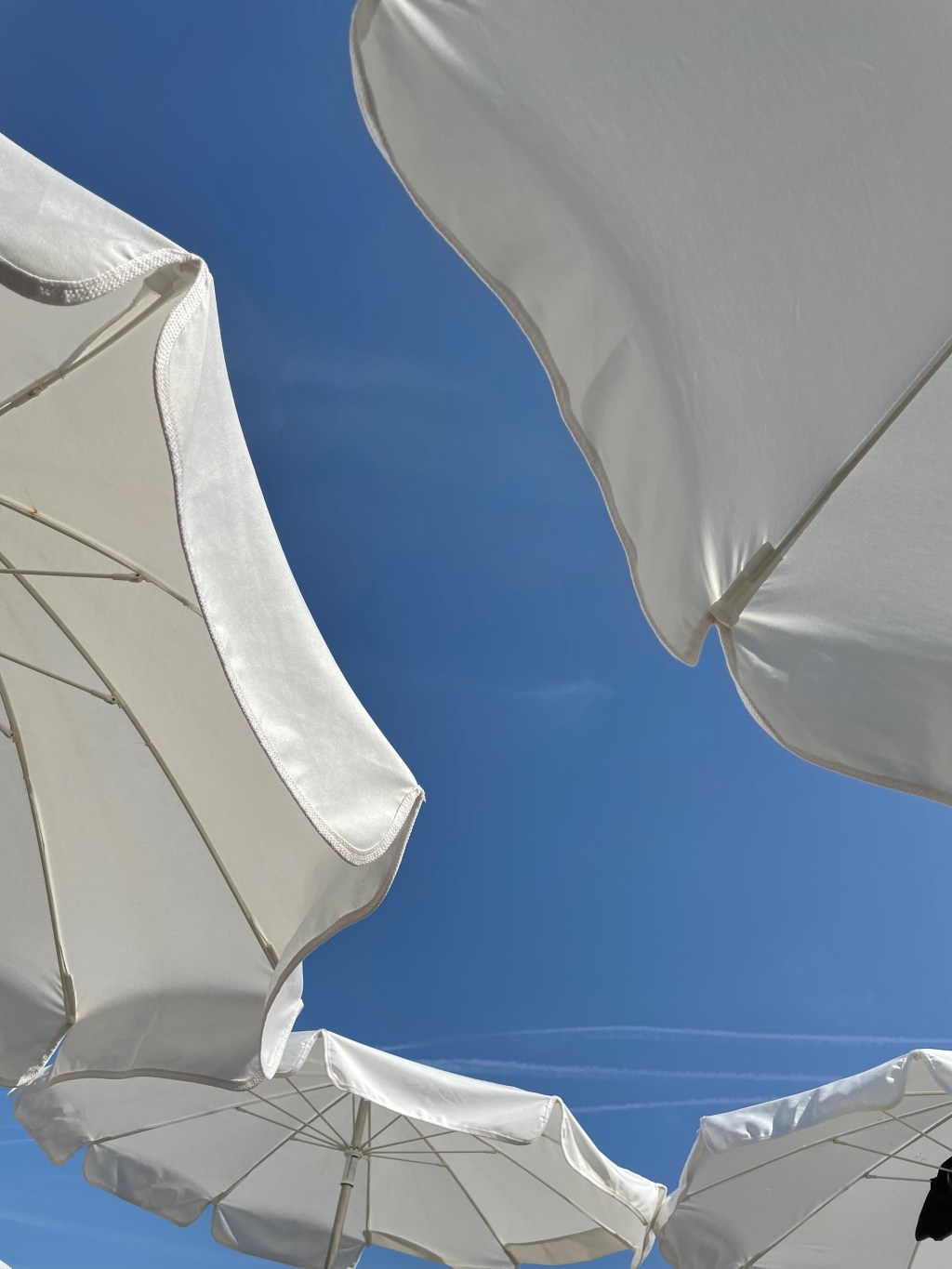
    It will usually take me a few days into my summer holiday to clam down and wind down to the point that I can actually pick up a book and just immerse myself into a story while glancing at the calming waves of the Adriatic or Mediterranean Sea. But doing so is just so very important. No massage, meditation or other procedure can bring me the same level of calm and wellbeing that 10 days by the sea can. The key here is to choose your hotel wisely (as always). For me, the most important aspect is the view. A hotel beach, which not only has its own sunbeds and umbrellas but also someone who moves those around for you for maximum shade and serves you iced coffee without you having to queue for it or schlepp around your wallet. You simply put it on the room and that’s it.
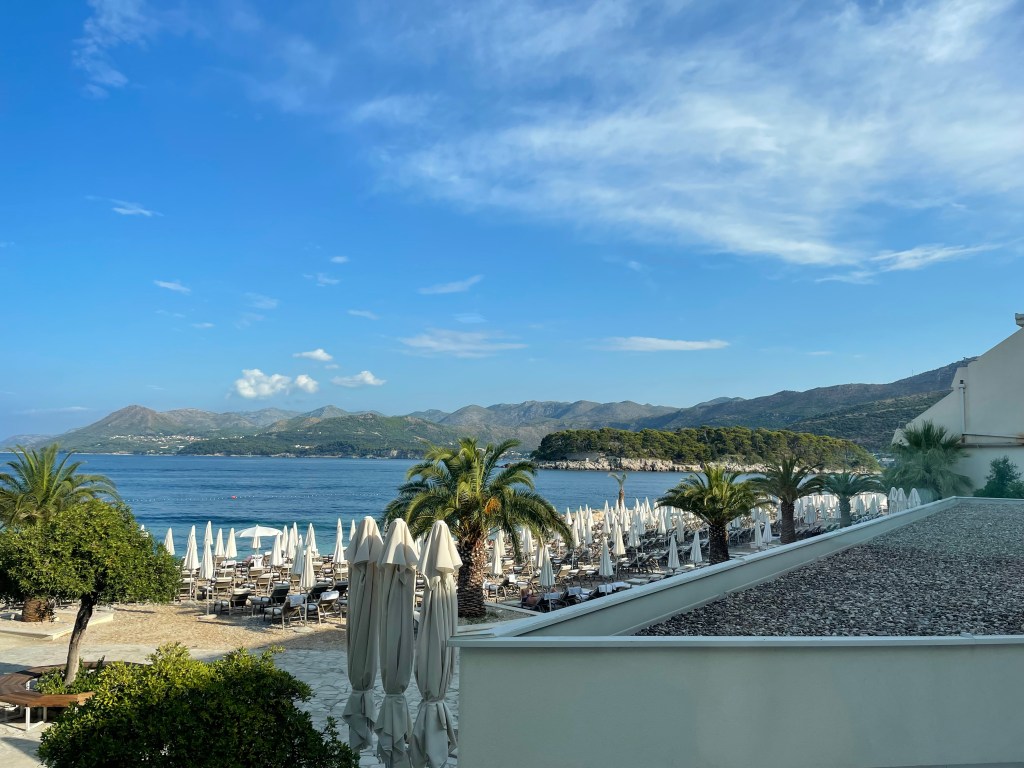
    Hotel beach on the Adriatic coast

    For my summer holiday, I like a larger hotel, so the ‘crowd’ you encounter is more diverse and you do not necessarily run into the same three couples at breakfast and in the beach bar where I would usually take a light lunch (because walking elsewhere does not fit into my lazy schedule). Ideally, my hotel would have a well-equipped gym, just so I can fit in two or three alibi workouts during this time, and a spa. Holidays are the time to really treat yourself and a good massage or facial can make a huge difference when combined with the dolce far niente lifestyle at the beach.

    sailing boat on the Adriatic at golden hour

    If you are in any way like me (and not spending beach time on your own for a change) lock your phone in the room safe. Don’t bring it to the beach. The world won’t end with you being unavailable for a couple of hours a day and, no, you do not need to check your email on vacation. If you really must, you can check it in the morning, at lunch and in the evening. Just give yourself a break for a few hours in between. Your brain will thank you for it.

    As for my beach side reads, I recommend something light and/or wholly unrelated to your everyday life or work. If you really want to relax, you should stay away from gruesome or overly depressing topics and intellectual depths. One good beach side read I remember was by Kamin Mohammadi – La bella figura

    This summer, I will bring Elif Shafak -There are rivers in the sky, as well as Sophie Kinsella – I owe you oneElena Ferrante – part 3 of the Napolitan Saga, Those who Leave and Those who StayI have read the first two parts of the Napolitan Saga in summers past and it is about time to carry on. Just in case I run out or don’t enjoy one of these books, I am also bringing along a novel by Danielle Steel – À tout prix I bought in France (mainly because it was printed in a decent font size and didn’t weigh 1.5 kg!) and started reading on my trip to Mallorca in June.
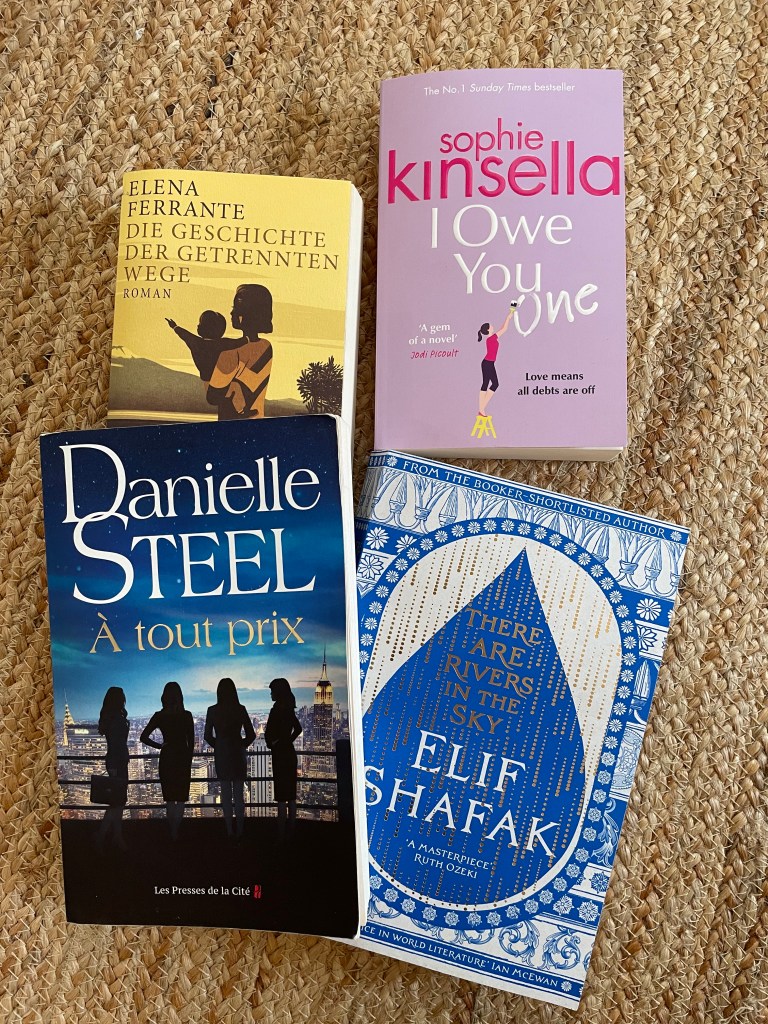
    Selection of colourful books

    If you are more into non-fiction, and use this relaxing and reflective time in a more targeted, self-improvement kind of way, I recommend the Mel Robbins – The Let Them Theory, which will give you plenty of food for thought but is also an easy enough read to turn the pages without too much reflection in between. 

    Another topic, besides beach side reads that I am very passionate about when it comes to beach holidays is SPF. Don’t be the lobster on the beach and don’t be that person that starts applying sunscreen after they already got fried in the morning sun. A key rule on SPF is to apply it before you even get to the beach and to apply it everywhere on your body, face, and yes, your feet and ears. You can thank me later. Of course, you’ll need to re-apply but it is so important to get yourself covered from the very beginning, literally. My favourite SPFs are LancasterClarins, and Shiseido. While I adore the Dior face SPF 50 and use it on a daily basis all year around, I don’t find it suitable for the beach. In my opinion, it is an ‘urban SPF’. For the face, I would recommend Shiseido instead (I will buy mine at the airport).
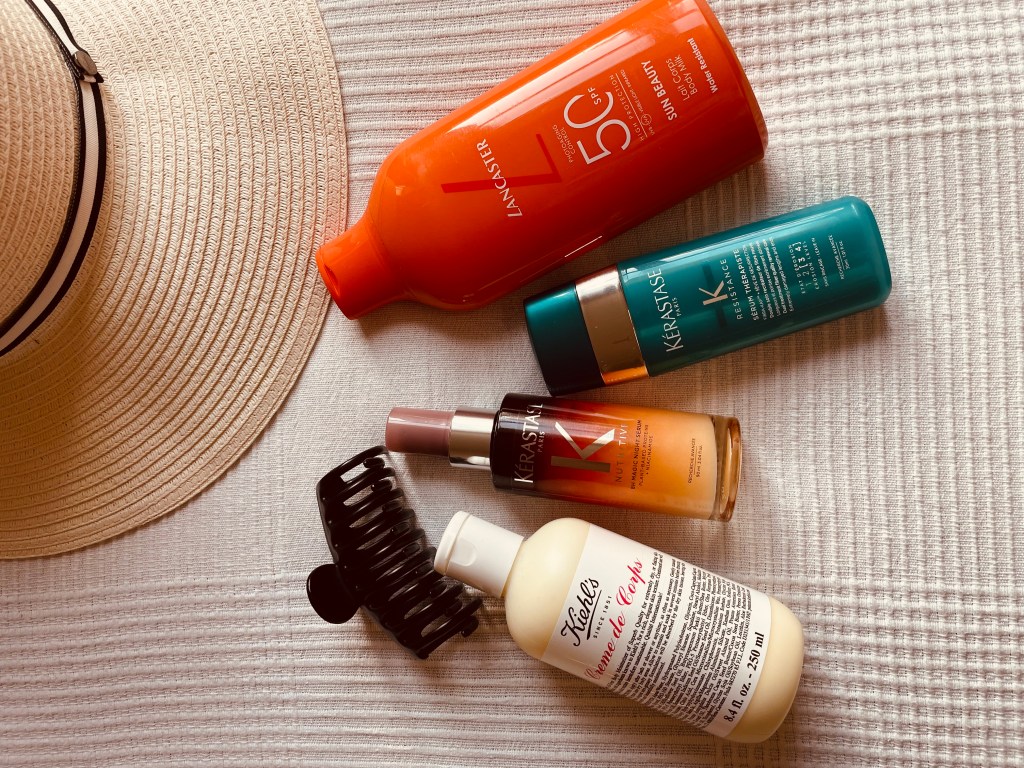
    Straw hat and several high-end beauty products

    I would recommend bringing a good moisturising body lotion as well, as most hotel size lotions just don’t cut it (apart from not ever being enough). One of my favourites is the Kiehl’s Creme de Corps.

    As for hair care … well. First of all, you should bring and wear a hat. But, nevertheless, your hair, especially if it is treated, will need A LOT of tender loving care during this period. Personally, I swear by Kérastase Nutritive Night Serum (to be applied into your dry hair overnight) and the Résistance Thérapiste Stengthening Healing Serum, which you apply into your wet hair. The latter is my absolute beach favourite.

    I wish you a wonderful, relaxing and resetting time of doing absolutely nothing for a bit this summer!

  • How coffee can ruin it all

    How coffee can ruin it all

    Have you ever stayed in a nice hotel but would never go back there because their breakfast coffee was just too bad? I have. And in fact, the coffee is a serious criterion for me when it comes to rating a hotel. 

    Shockingly, most of the places I would discount for future stays despite good locations and other good attributes for the simple reason that their coffee was undrinkable were located in heartland of coffee: Italy. A few years back, I travelled to Rome. I stayed in a four-star hotel that seriously only had a coffee machine, the kind of which you would find in a hospital lobby.

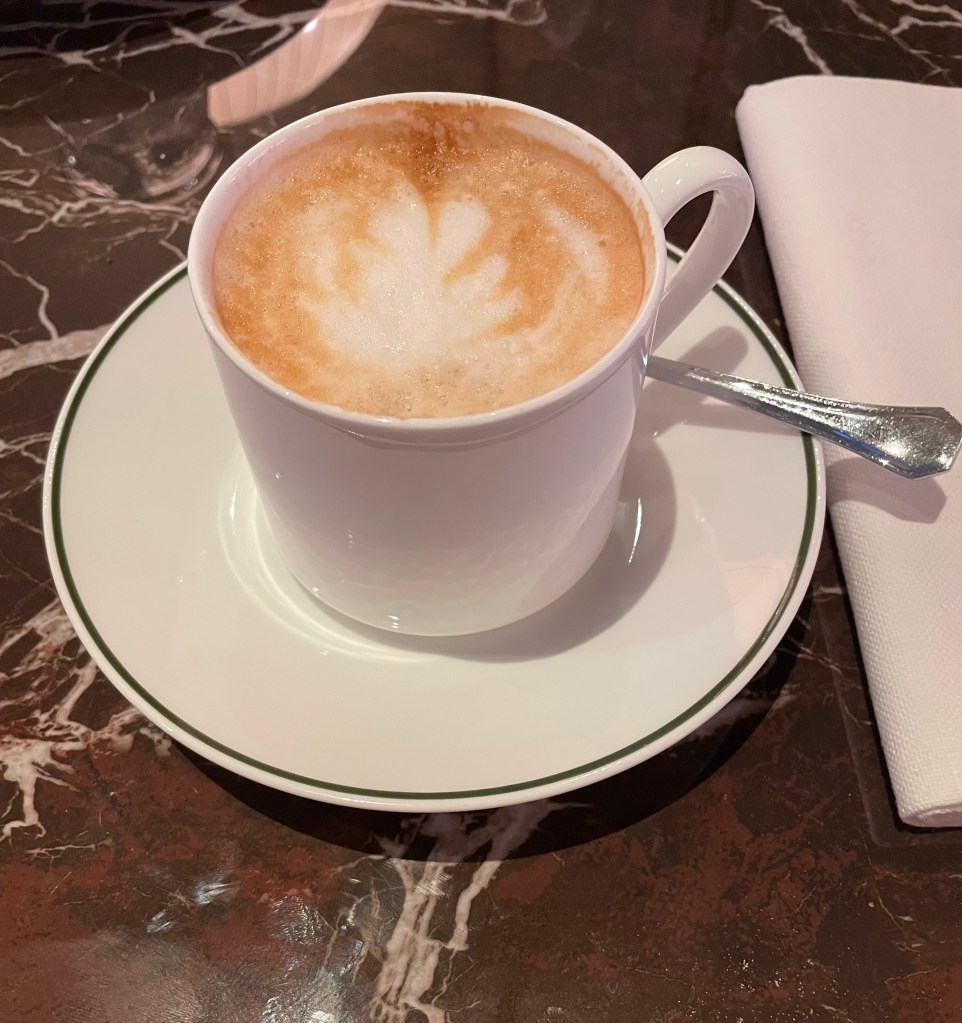
    It was truly shocking. However, it was not the only such place in Italy I came across. I also managed to find another four-star hotel in Milan that was similar in that regard (the one close to the hair salon I told you about two weeks ago). The hotel was actually very nice, had a great location and nice staff, but I just could not get over the coffee. For me, my morning coffee is the most important event of the day. It is non-negotiable, and it needs to be a good, strong, flavoursome latte or cappuccino; and from a four-star hotel that charges a couple of dozens of Euros for breakfast, I also expect excellent foam on a barista-made coffee and not something I have to get out of a 1990s machine. Call me high-maintenance, but I really cannot accept that. It’s not like I am asking for champagne. 

    cappuccino in a posh cup on a marble table

    Another coffee-related ‘won’t go there again’ criterion I apply to hotels is the in-room coffee situation. 

    Don’t get me wrong, back in the day when I could barely afford a 3-star hotel or bed and breakfast, I was very happy if there was a clean kettle and a few sachets of Nescafé (or the local spin-off) in the room. It is completely fine and acceptable for that category of hotel and at least it woke me up. What I do not find acceptable though is when you are staying at a higher category place and you cannot even make yourself an espresso in the room. After all, you should get what you pay for.

    Recently, I stayed in a four-star hotel in Mallorca – with a 5-star price minus the service – that offered exactly that. A kettle and an IKEA mug (the kind you find abandoned in the office kitchen) with one sachet of local Nes and no spoon to stir it in sight. I honestly could not believe it. Worse yet, when I checked out after having had my “big breakfast” as they called it, the lady honestly told me: “I see you had one additional coffee for breakfast [Yes, I tend to drink two, especially when there’s none in the room] … But it’s OK, I’ll gift it to you.” I was gobsmacked. I literally paid an arm and a leg for the night and here she was counting my coffees. It wasn’t the lack of service, the ineffective aircon, lack of toiletries or sub-par restaurant recommendations that got me about this hotel; no, it was the coffee remark that immediately made me think: Bye-bye, hotel, you will never see me again. 

    During that stay in Spain, I moved to another hotel the next day. Initially, because I had had a change in dates for my trip, but also because the first hotel I stayed at was just terribly overpriced. The second hotel wasn’t much better when it came to their coffee-rating. There was no facility, not even a kettle in the room and the breakfast coffee (yes, from the infamous hospital lobby machine) was so undrinkable (thin and sweet somehow and that’s your black coffee with no added sugar button) that I will not choose this hotel next time I go. It’s a shame, because many other aspects of it were actually good. 

    Isn’t it the simple things like that, or at least things I believe could be very simple that make or break a hotel stay for you? I really do not understand why so little attention is paid to this aspect of hospitality, especially in countries with an excellent coffee culture. For me, great coffee can easily take a hotel from 6 out of 10 to 10 out of 10 points and the bad coffee can do the exact opposite. In fact, it is so important to me that when I started upgrading the kind of accommodation I would stay at, I would check whether the hotel had an in-room coffee machine running on capsules and save on breakfast altogether, bringing a pack of oatmeal to get me going in the morning and shaving off a good 30€+ a night from the grand total. Just the coffee was the non-negotiable part in it. In most European cities you would anyway want to try the local bakeries and buy a croissant for less than a tenth of the breakfast charge while being happily caffeinated. It was the best deal for me at the time and one that allowed me to go to nicer hotels when my budget was tight. 

    As my employment situation improved and travel budgets grew out of the student years, I have become a huge fan of hotel breakfasts. They can really make you feel like you are truly on a holiday, but coffee still plays the biggest role in them for me.

    And while you cannot know the coffee situation in the breakfast room before you book, you can scan the pictures and read the small print to find out whether there’s at least a machine in the room that will take you from sleepy to happy in the morning! Just don’t over-do it. You might be allowed only one 🙂

  • The art of dining alone 

    The art of dining alone 

    Chapter 2: Getting started

    If you have followed my blog and read chapter 1 published the week before last you will have understood that for many years of travelling, I did not muster up the courage to go and dine out alone. I felt judged, stared at, or worse even: pitied. 

    Don’t get me wrong, at times these feelings still creep up depending on the environment I find myself in, but in general I have learned to just let other people mind their own business while I mind my own.

    And this brings me to what I want to reflect upon today. In my opinion, the environment and circumstances in which you find yourself matter very much. For instance, I find urban dining much easier than say beach location dining. Of course, this is not a hard and fast rule, but I am just speaking about my own experiences here anyway. I have come to this particular realization after some not-so pleasant meals by the beach during summer vacations. To me, being in a more urban environment makes it easier, as dining is more of an everyday business affair rather than an event in itself which it often is when people take a break by the sea. I think by now, I have a few tips to share about how I managed to transition from in-room meals to venturing out and eating in a restaurant by myself. 

    If you are struggling with this situation, too, I think you need to start out easy and make it as comfortable as possible for yourself. My advice would be to start with eating in the hotel restaurant where you are staying. In my opinion, it is the easiest kind of “situation” because you don’t need to take transport, and chances are there are other solo diners owing to the simple fact that hotels have business travellers. 

    I had very good experiences at various hotels I have stayed at, but on the top of my head I can think of hotel Alfred Sommier in Paris and the Fairmont hotel in Amman, Jordan. The latter has an excellent steakhouse and a Lebanese restaurant.

    Sure, going down for dinner isn’t much of a move, but this is the entire point. It will be a good starting point and much better than sitting in your room eating in front of the TV in your PJs.

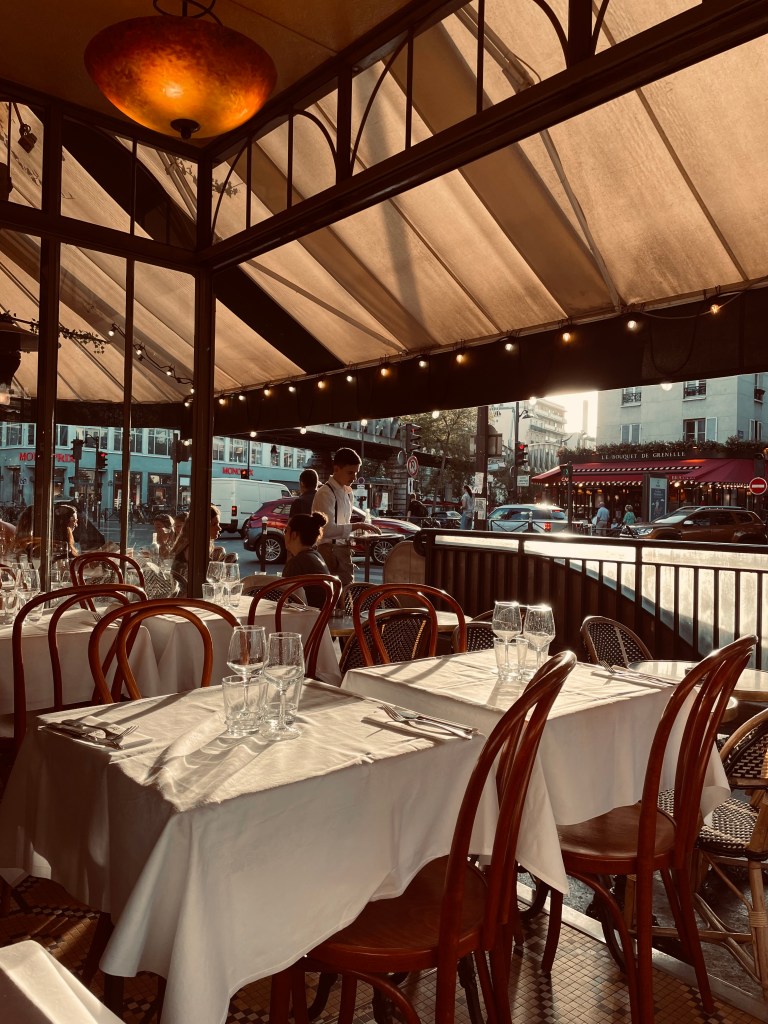
    Level 2 would be to stay local and try a bistro or restaurant close by the hotel. Usually, these places – in Paris for instance – are lunch and dinner places and very unfussed. If you are travelling in summer, most of them will have a terasse or a few tables out in front, where you can engage in some Parisian-style people watching, which is a wonderful way to make dinner for one more entertaining.

    evening sun hitting on a typical Parisian bistro table

    I can recommend a few bistros close to the Champs de Mars in Paris, such as le Café Picquet on Avenue de la Motte Picquet or Le Pierrot for that purpose, but generally speaking, there are so many similar ones in Paris – just give it a try. I only mention these here because I have been there, tried them, and liked them, not because they are particularly fancy, special or outstanding. Sitting on a terasse facing the street is in my opinion a perfect setting for a solo-dinner. 

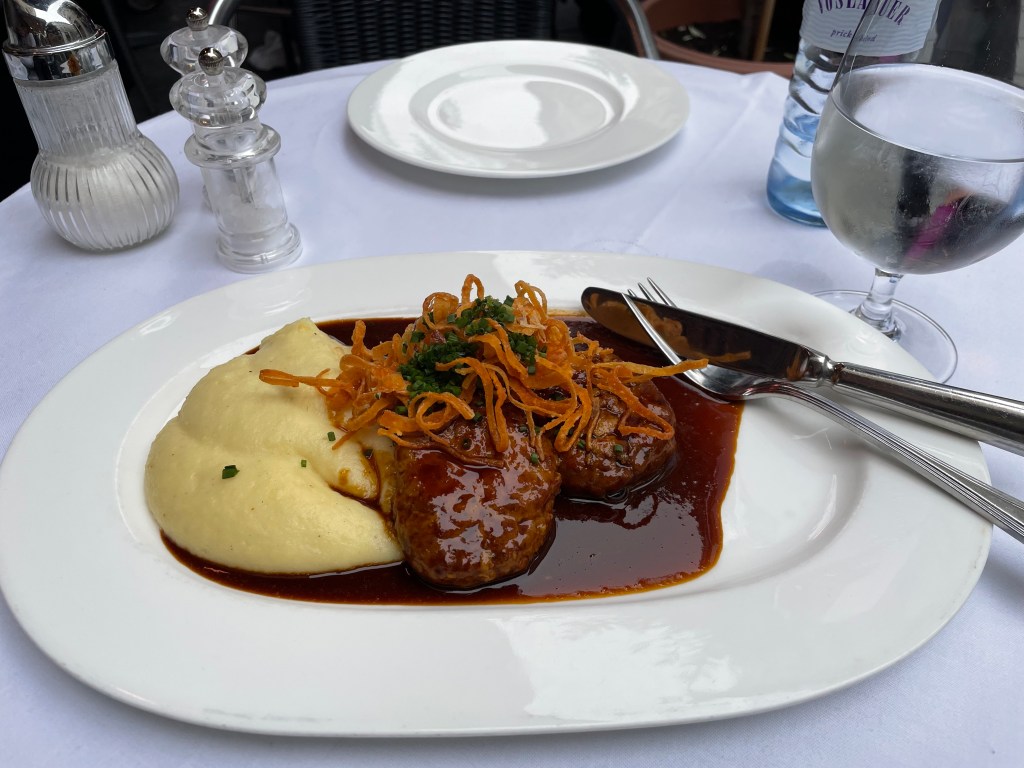
    view of a hearty meal at Yum Schwarzen Kameel

    In the same vein I can recommend Zum Schwarzen Kameel in Vienna centre, which is a bar, bistro, restaurant with a rich tradition and equally a place for apéritif. It is basically open all day and has a beautiful outdoor sitting area in front.

    You can go for breakfast, lunch or dinner as it is always busy and popular. Maybe you want to start with an afternoon drink and transition into dinner. I have been there on different occasions and it is very popular with the locals for after work drinks. You may have to queue for a bit, but to me that is just a sign of excellent quality.

    Vienna is a safe and beautiful place to stroll, and I really urge you to explore the local options when you are there, and not just for cakes!

    Another way of easing yourself into the habit of dining out alone is going to a mall. In Dubai for example, I have had great dinners in some of the many restaurants in the mall where you just join one of the other shoppers stopping for a bite. There are way too many options to list here, but one place I find very easy (no matter where) is the Japanese chain Wagamama, which is also a great option for London, Amsterdam or Copenhagen. 

    It can of course be daunting and boring to eat on your own, but I really think that it is an act of self-respect to put on some nice clothes and get yourself out there to partake in adult life instead of hiding in the room. 

  • Café con leche

    Café con leche

    Café con leche – probably the first words I learned in Spanish on a trip with my beloved late grandmother. I was 10 years old and she took me to the Island of Lanzarote, to a wonderful luxury hotel where I thoroughly enjoyed myself and stole almost all of the little soap bars we received from room service every day.At breakfast, she taught me how to ask the waiters for things and I clearly remember how she taught me to ask for a café con leche for her. It was a magnificent holiday. My first flight, my first words in a foreign language, reading paper maps in the car while directing her along the road; seeing volcanos and cacti plantations and her buying me my first pair of real Converse All Stars in bright green. I am still obsessed with Converse All Star some thirty odd years later on …

    Days like these make me miss my gran very much. I loved travelling with her. Widowed in her early 30s after coming to a foreign country, she was the ultimate role model I could ever have hoped for. I wish she were here with me today, on another Spanish island, ordering café con leche

    I believe that people we love and admire as children often inspire us. And it is only recently that I realized how much my grandmother inspired me to travel and to explore. She was unafraid, interested in culture, food and exploring. She even travelled through Turkey alone, taking the overland buses in the 80s!

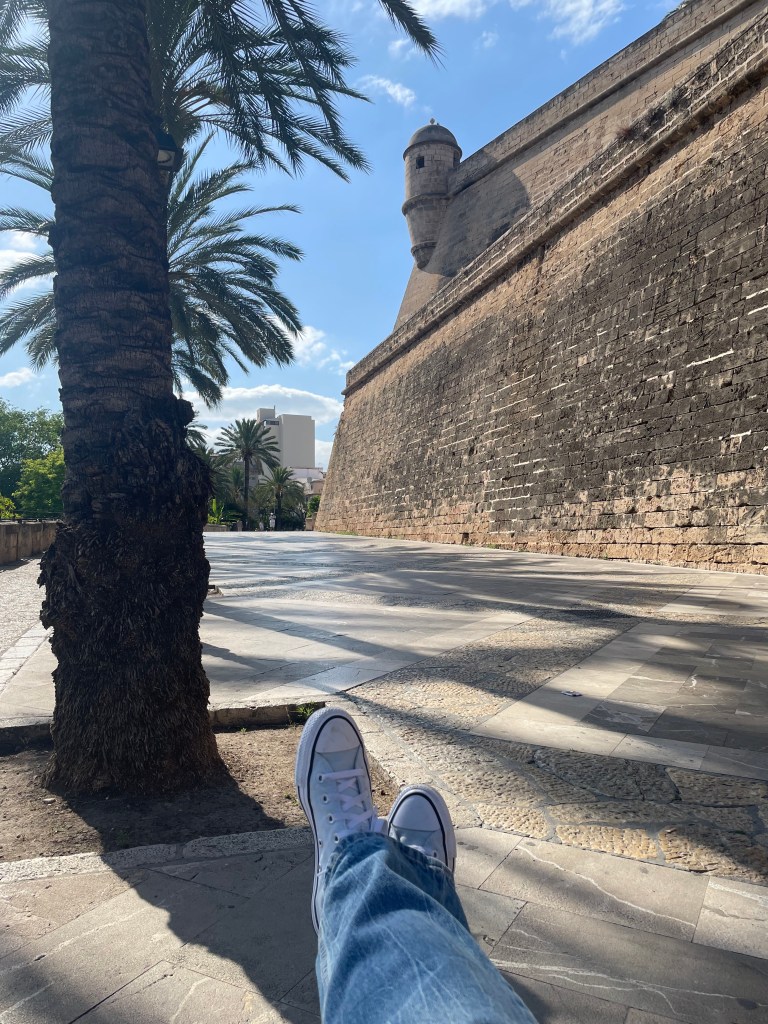
    converse all star in front of Spanish fortress

    This time, I travelled to Palma de Mallorca on my own and because of some commitments, I did not get to explore the island outside of the capital. But what I can definitely say is that I will come back. I have been so pleasantly surprised by how well I was treated in the restaurants asking for a table for one. There was nothing judgmental or weird about it, contrary to many other places I have visited in the past. Nobody made me feel lonely, and that is a feeling that any woman travelling by herself knows how to cherish. I felt safe and comfortable and I am very grateful for that.

    If you also love café con leche with maybe something sweet on the side, I can warmly recommend the very cute and old school Ca’n Joan de s’Aigo where the coffee was fantastic and the enseimada absolutely worth it. 

    view of Enseimada, coffee and ice cream at Ca'n Joan de s'Aigo

    I was told about this place by a local and he said I should try the ice cream with an enseimada or cuarto, but to be very honest, I did not love the ice cream. If you like sorbet, it’s definitely for you, but I am more of an Italian gelato kind of girl, so it just did not hit the spot for me. That said, I took strawberry – so maybe the chocolaty-nutty-type of flavours may be different. I will happily check this for you next time I go!

  • About this blog:

    About this blog:

    Hi there! My name is Ana. I am visually impaired and single. But guess what? I love travelling. I love exploring. I love taking pictures, and I love comfort. And this is why I have called this blog the comfy traveller’s diaries. 

    Everybody loves comfort, right? But when I am speaking about comfort in the context of travel, I am speaking about the good kind of comfort; not the kind of comfort that keeps you trapped on your sofa with your hand stuck in a bag of crisps. 

    And this is the entire point of my travel blog: How to leave your mental comfort zone in a comfortable way.

    The kind of comfort I am talking about is probably more aptly described or synonymous with “well-being”. How do you travel well? Especially when you are on your own, and when you aren’t able to drive – and therefore – hire a car.

    Travel should be fun and beautiful and should make you richer in experiences and memories.

    As a (disabled) woman travelling on her own, I have quite a few thoughts about these concepts, as well as past experiences from which I learned in that regard.

    So, when I talk about comfortable travel, I talk about making better choices in the way you travel.

    Many years of solo-travel have taught me that you do not only pay for things in monetary terms. You pay with your time, your peace of mind, your stress and anxiety levels, your safety, your self-esteem, and yes, of course, with cold hard cash.

    With this blog, I want to share tips and experiences on how to travel more comfortably. I want to share thoughts and impressions of my travels. As a solo-traveller, I have a lot of time and opportunity to observe, to learn, and to take in impressions. But being passionate about my travels, I also want to share what I learned.

    I would love to be able to reach an audience that appreciates my travel diary, and I hope you are here to stay for that! 

    Thank you so much,

    Ana.